





GMAT Data Insights – Mock Test
This mock test covers the Data Insights section of the GMAT Focus Edition. It consists of Graphs & Tables, Table Analysis, Two-Part Analysis, and Multi-Source Reasoning questions designed to replicate real exam conditions.
Instructions: Answer all questions before revealing the answers at the bottom of the page.
Question 1 — Graphs & Tables
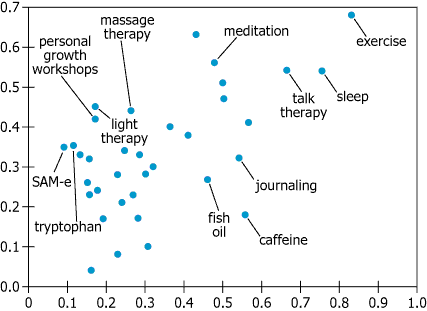
The graphic above displays results of an Internet survey on the effectiveness of treatments for depression. The vertical axis (F) represents the fraction of respondents who considered a given treatment to be effective. The horizontal axis (P) represents the fraction of respondents who tried a given treatment.
Sub-question 1: Based on the graphic, which treatment was considered both the most effective and tried by the most respondents?
- A) Journaling
- B) Massage therapy
- C) Light therapy
- D) Meditation
- E) Exercise
Sub-question 2: Among the treatments tried by more than half of all respondents (P > 0.5), which was considered the least effective?
- A) Fish oil
- B) Journaling
- C) Caffeine
Question 2 — Table Analysis
The table below shows the number of businesses and jobs within each economic sector of a particular city.
| Economic Sector | Number of businesses | Percent of total businesses | Number of jobs | Percent of total jobs |
|---|---|---|---|---|
| Construction | 443 | 8.0% | 2,368 | 3.9% |
| Finance | 398 | 7.2% | 2,958 | 4.9% |
| Government | 292 | 5.3% | 8,742 | 14.5% |
| Manufacturing | 214 | 3.9% | 8,012 | 13.2% |
| Miscellaneous | 272 | 4.9% | 1,444 | 2.4% |
| Retail Trade | 1,380 | 25.0% | 11,845 | 19.6% |
| Services | 2,040 | 37.0% | 19,502 | 32.2% |
| Transportation | 185 | 3.4% | 2,346 | 3.9% |
| Wholesale Trade | 291 | 5.3% | 3,279 | 5.4% |
| Total | 5,515 | 100% | 60,496 | 100% |
For each of the following statements, select Yes if the statement is true based on the information provided, or No if it cannot be determined or is false.
| Statement | Yes / No |
|---|---|
| The sector with the greatest number of businesses has the greatest number of jobs. | |
| The sector with the least number of businesses has the least number of jobs. | |
| There are two economic sectors that together comprise over half of all jobs in the city. |
Question 3 — Table Analysis
The table below displays data on Brazilian agricultural products in 2009.
| Commodity | Production, world share (%) | Production, world rank | Exports, world share (%) | Exports, world rank |
|---|---|---|---|---|
| Coffee | 40 | 1 | 32 | 1 |
| Orange juice | 56 | 1 | 82 | 1 |
| Sugar | 21 | 1 | 44 | 1 |
| Beef | 16 | 2 | 22 | 1 |
| Soybeans | 27 | 2 | 40 | 2 |
| Chickens | 15 | 3 | 38 | 1 |
| Corn | 8 | 4 | 10 | 2 |
| Pork | 4 | 4 | 12 | 4 |
| Cotton | 5 | 5 | 10 | 4 |
For each of the following statements, select Yes if the statement is true based on the information provided, or No if it cannot be determined or is false.
| Statement | Yes / No |
|---|---|
| No individual country produces more than one-fourth of the world's sugar. | |
| If Brazil produces less than 20% of the world's supply of any commodity listed in the table, Brazil is not the world's top exporter of that commodity. | |
| Of the commodities in the table for which Brazil ranks first in world exports, Brazil produces more than 20% of the world's supply. |
Question 4 — Two-Part Analysis
Read the following excerpt carefully, then answer the two-part question below.
For zoologists studying the behavior of certain species of birds, the critical importance of observing the birds in those species' morefa during the annual breeding season is obvious. Such observation allows researchers to study not only the courtship displays of many different individuals within a species, but also the species' social hierarchy. Moreover, since some species repeatedly return to the same morefa, researchers can study changes in group dynamics from year to year. The value of observing a morefa when the birds are not present, however — such as prior to their arrival or after they have abandoned the area to establish their nests — is only now becoming apparent.
Based on the definition of the term morefa that can be inferred from the passage, identify which activity must happen in a location for it to be a species' morefa, and which activity must NOT happen in that location.
Make only two selections, one in each column.
| Activity | Must happen | Must NOT happen |
|---|---|---|
| A) Occupying the location only once per year | ||
| B) Occupying the location multiple times | ||
| C) Establishing nests | ||
| D) Gathering together with members of their own species | ||
| E) Competing territorially with members of other species |
Question 5 — Two-Part Analysis
Loan X has a principal of $10,000x and a yearly simple interest rate of 4%. Loan Y has a principal of $10,000y and a yearly simple interest rate of 8%. Loans X and Y will be consolidated to form Loan Z with a principal of $(10,000x + 10,000y) and a yearly simple interest rate of r%, where:
r = (4x + 8y) / (x + y)
In the table below, select a value for x and a value for y corresponding to a yearly simple interest rate of 5% for the consolidated loan. Make only two selections, one in each column.
| X | Y | Value |
|---|---|---|
| 21 | ||
| 32 | ||
| 51 | ||
| 64 | ||
| 81 | ||
| 96 |
Question 6 — Multi-Source Reasoning
Read the two passages below, then answer the three questions that follow. The third question also refers to the additional scenario provided.
Economist
Do expenditures on road construction projects represent good investments for communities? The taxpaying public will never know because community planners rarely analyze road projects as investments. The benefits that local residents will receive from a new or improved road, such as increased efficiency, fewer accidents, and reduced vehicle operating costs, as well as the potential regional impacts on jobs, population, and income, should be measured. These benefits should then be compared with the total construction costs of the project, such as planning and design, land purchases, construction, and costs for moving utility lines. Only then will any investment in building or improving roads be made with reasonable confidence.
Ecologist
Community planners should consider the full range of ecological effects of any road construction projects, including pollution, vegetation destruction, habitat fragmentation, and soil erosion. The scale of the effects varies with the size of the project. Evaluations based on only a few species or resources may be adequate for small projects, but the construction of several highway systems can together alter entire regions, disrupting migratory pathways and other ecosystem processes. These effects may be augmented by the conversion of land to industrial or residential use that usually accompanies road building. Once all of the environmental considerations have been evaluated, planners should proceed with a proposed road construction project only if it will not damage sensitive ecosystems or if suitable mitigation measures can be implemented.
Sub-question 1: Based on the information given, which one of the following can be most logically inferred?
- A) The ecologist faults community planners generally for not considering the effect of converting land to industrial or residential use.
- B) The economist would allow road construction to proceed even if it would threaten sensitive ecosystems.
- C) Both the economist and ecologist offer guidance for planners who are considering whether to undertake road construction projects.
- D) Both the economist and the ecologist consider the regional economic impacts of road construction projects.
- E) Neither the economist nor the ecologist provides clear criteria for determining whether a road project should be undertaken.
Sub-question 2: For each of the following statements, select Yes if the statement is supported by the information provided. Otherwise select No.
| Statement | Yes / No |
|---|---|
| The economist is more intent on endorsing road construction projects than the ecologist is. | |
| The economist and the ecologist are both concerned with the criteria on which community planners base decisions. | |
| The ecologist is concerned with how road projects can affect the quality of life within communities, whereas the economist is not. |
Additional scenario for Sub-question 3:
Community planners are evaluating whether to build a new road that is projected to cost $2.0 million to construct and provide $2.5 million in overall benefit to the region but that will threaten a sensitive local ecosystem.
Sub-question 3: In the columns, select Acceptable for each detail that would make the new road acceptable under the standards provided by both the economist and the ecologist. Otherwise, select Not acceptable.
| Detail | Acceptable | Not acceptable |
|---|---|---|
| The road's planned route could be altered to avoid the sensitive ecosystem at no additional cost. | ||
| The road would provide a significant economic benefit to neighboring communities. | ||
| Mitigating the threat to the sensitive ecosystem would cost an additional $1 million. |
More questions coming soon.
Answer Key
▶ Reveal Answers
These are the answers and sources from the quizQuestion 1 — Source
| Sub-question | Answer | Difficulty |
|---|---|---|
| Sub-question 1 | E) Exercise — The dot for exercise is positioned furthest to the right (highest P — most tried) and highest on the vertical axis (highest F — most effective). | Easy |
| Sub-question 2 | C) Caffeine — Among treatments with P > 0.5, caffeine sits the lowest on the effectiveness (F) axis, meaning many people tried it but few found it effective. | Easy |
Question 2 — Source
| Statement | Answer | Difficulty |
|---|---|---|
| The sector with the greatest number of businesses has the greatest number of jobs. | Yes — Services has both the most businesses (2,040) and the most jobs (19,502). | Medium |
| The sector with the least number of businesses has the least number of jobs. | No — Transportation has the fewest businesses (185), but Miscellaneous has the fewest jobs (1,444). These are different sectors. | Medium |
| There are two economic sectors that together comprise over half of all jobs in the city. | Yes — Retail Trade (19.6%) + Services (32.2%) = 51.8% of total jobs. | Medium |
Question 3 — Source
| Statement | Answer | Difficulty |
|---|---|---|
| No individual country produces more than one-fourth of the world's sugar. | Yes — Brazil is the #1 sugar producer at only 21%. Since even the top producer is below 25%, no country can exceed one-fourth of world sugar production. | Hard |
| If Brazil produces less than 20% of the world's supply of any commodity, Brazil is not the world's top exporter of that commodity. | No — Brazil produces only 16% of beef and 15% of chickens (both under 20%), yet ranks #1 in exports for both. These are direct counterexamples. | Hard |
| Of the commodities for which Brazil ranks first in world exports, Brazil produces more than 20% of the world's supply. | No — Brazil ranks #1 in exports for coffee, orange juice, sugar, beef, and chickens. However, beef (16%) and chickens (15%) are both below 20% production share, disproving the statement. | Hard |
Question 4 — Source
| Column | Answer | Difficulty |
|---|---|---|
| Must happen | D) Gathering together with members of their own species — The passage describes researchers studying courtship displays and social hierarchy in the morefa, both of which require birds of the same species to be present together. | Hard |
| Must NOT happen | C) Establishing nests — The passage explicitly states that birds abandon the morefa to establish their nests elsewhere, making nest-building incompatible with the morefa by definition. | Hard |
Common trap: Option B (occupying the location multiple times) is tempting because the passage says "some species repeatedly return." However, the key word is some — not all species do this, so it cannot be a required condition.
Question 5 — Source
| Column | Answer | Difficulty |
|---|---|---|
| X | 96 | Medium |
| Y | 32 | Medium |
Explanation: Set r = 5 and solve: 5 = (4x + 8y) / (x + y) → 5x + 5y = 4x + 8y → x = 3y. Only x = 96 and y = 32 satisfy this 3:1 ratio among the given values.
Question 6 — Source
| Sub-question | Answer | Difficulty |
|---|---|---|
| Sub-question 1 | C) Both the economist and ecologist offer guidance for planners considering road construction. The economist advises measuring costs vs. benefits; the ecologist advises evaluating ecological impact. Both provide clear criteria. | Medium |
Sub-question 2:
| Statement | Answer | Difficulty |
|---|---|---|
| The economist is more intent on endorsing road construction projects than the ecologist is. | No — Neither passage endorses road construction outright. Both simply provide criteria for planners to consider. | Medium |
| The economist and the ecologist are both concerned with the criteria on which community planners base decisions. | Yes — Both passages explicitly address what planners should evaluate before proceeding with a road project. | Medium |
| The ecologist is concerned with how road projects can affect the quality of life within communities, whereas the economist is not. | No — The economist also addresses quality-of-life factors such as efficiency, accidents, and vehicle costs. | Medium |
Sub-question 3:
| Detail | Answer | Difficulty |
|---|---|---|
| The road's planned route could be altered to avoid the sensitive ecosystem at no additional cost. | Acceptable — Rerouting avoids ecosystem damage (satisfying the ecologist) and at no extra cost the benefit ($2.5M) still exceeds cost ($2.0M) (satisfying the economist). | Medium |
| The road would provide a significant economic benefit to neighboring communities. | Not acceptable — Economic benefit alone does not satisfy the ecologist's requirement that the sensitive ecosystem not be damaged or mitigated. | Medium |
| Mitigating the threat to the sensitive ecosystem would cost an additional $1 million. | Not acceptable — Mitigation would satisfy the ecologist, but total cost would rise to $3.0M, exceeding the $2.5M benefit — failing the economist's cost-benefit standard. | Medium |